Battle Climb Racing
- 4.6
- Rating
- 1.00M
- Installs
- Free
- Price
 Analysis by App-foxy
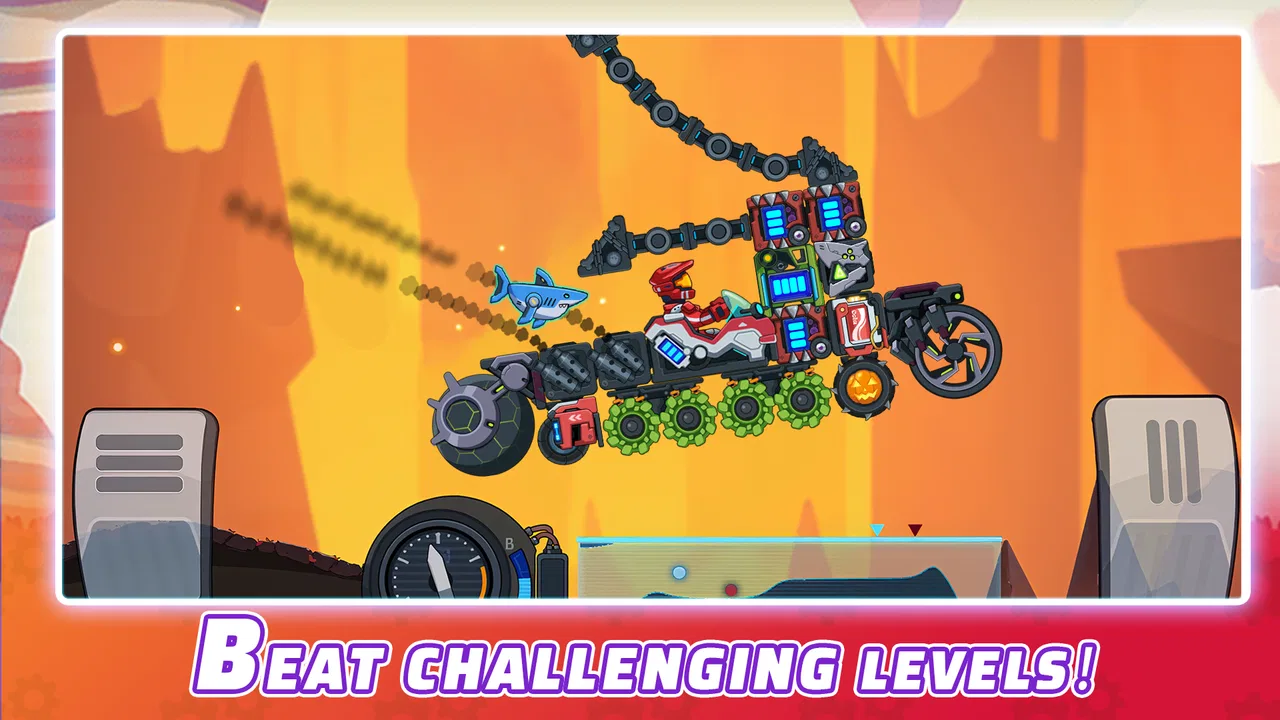
Battle Climb Racing is the kind of mobile racing game I reach for when I want short, hands-on challenges rather than a serious motorsport simulation. Developed by Hks Games, it places custom-car building and physics-based hill racing at the center of the experience. I found that combination more interesting than the simple “drive uphill” idea suggests, because small changes in how I accelerate, land, and prepare the car can decide whether a run feels controlled or completely falls apart.
The game is free to play and aimed at Everyone, which makes it easy to recommend for casual sessions with family or friends. It is also a competitive game, with player-versus-player battles adding pressure beyond simply reaching the end of a course. The store page presents it as a racing game, but my experience is closer to a blend of arcade driving, vehicle tuning, and repeated problem-solving. You are not only trying to go faster; you are learning how the car reacts when the ground changes underneath it.
That distinction matters. If you want realistic licensed cars, long championship races, or a detailed simulation model, this is not the right direction. If you enjoy experimenting with a vehicle, retrying a tricky climb, and gradually turning awkward physics into a useful skill, Battle Climb Racing has a much stronger appeal.
You May Also Like

 Blood Strike: 2.5 Anniversary
Blood Strike’s Loadouts Turn Every Drop Into a Tactical Gamble
A close look at Blood Strike’s custom loadouts: how fast access to signature weapons reshapes its battle royale rhythm, rewards preparation, and narrows the gap between fights.

 Pandora - Music & Podcasts
Pandora’s Music Is Easy to Start, but Harder to Recover
Pandora’s strength is its low-effort path from a seed to a station. Its weak spot is how much confidence it asks you to place in connection, setup, and quiet recovery.

 8 Ball Pool
 Is Built on Rivalries, Rematches, and Routine
A close look at the rivalries, rematches, shared routines, and unanswered safety questions that turn a quick pool match into a persistent mobile community.

 Samsung Music
’s Quiet Strength Is Playing What You Already Own
Its reach comes less from spectacle than from dependable access to a personal library. That simplicity is both the app’s strongest retention engine and its ceiling.

 AccuWeather: Weather Radar
AccuWeather Review: A Quick, Clear Forecast for Everyday Decisions
For everyday plans, the best forecast is the one you can understand quickly. AccuWeather makes rain timing, radar, and local conditions easy to act on, with a few trade-offs.

 Hill Climb Racing
Why Hill Climb Racing Still Turns Crashes Into One More Run
A tiny car, a bumpy hill and one more upgrade: Hill Climb Racing keeps resurfacing because its simple chaos makes every near-miss feel personal.
More From Our News Desk
View All News


How I approach a normal session
My baseline workflow is simple: I begin with a few relaxed runs before trying to win aggressively. The first attempt is useful for reading the terrain and noticing where the car loses balance. Instead of treating every crash as a failure, I use it to identify the moment that caused the problem. Was I accelerating too hard before a rise? Did I land with the front end too low? Did I enter a slope with the car already tilted?
This way of playing makes the physics easier to understand. Hill-climb racing rewards patience more than constant input. Holding the accelerator down may feel natural, especially when an opponent is nearby, but it can make the car bounce, rotate, or lose its grip at exactly the wrong time. I get better results by treating the throttle as a tool for positioning the car, not just as a command to go faster.
On a typical break, I might play several short attempts, stop after finding one repeatable mistake, and return later with a specific adjustment in mind. That is more productive than rushing through a long series of retries without changing anything. The game suits this routine because each attempt gives immediate feedback, and the core challenge remains readable even when the result is frustrating.
Custom-car building adds another layer to that routine. I prefer making one change at a time rather than rebuilding everything after every loss. When several adjustments happen together, it becomes difficult to know which one helped. A slower but more stable setup can be more valuable than a powerful one when the course contains sharp rises or awkward landings. In competitive battles, consistency often beats a car that looks impressive on paper but is difficult to control.
One useful habit is to separate learning runs from winning runs. During a learning run, I deliberately test how early I can accelerate, how much the car can rotate in the air, and how it behaves after landing. During a winning run, I stop experimenting and repeat the safest pattern I already understand. That separation prevents me from changing tactics in the middle of a close battle simply because I want a slightly faster time.
Settings that deserve attention
I always check the available control and display options before settling into the game. In a physics-heavy racer, comfort is not a cosmetic issue. If the steering method feels awkward or the screen is difficult to read, I react later than I should and then blame the vehicle. Taking a moment to test the controls in a low-pressure run is more useful than trying to adjust them while an opponent is already ahead.
The best setting is the one that lets me make small corrections without oversteering. Hill sections often require a tap or brief directional change rather than a dramatic movement. I also pay attention to whether the interface leaves enough of the course visible. Seeing the next rise early helps me choose whether to build speed, prepare for a landing, or approach more cautiously.
Sound is worth considering as well. I prefer to keep enough audio feedback to notice impacts and engine changes, but I lower it when playing in public or while listening to something else. The game remains playable without making it the loudest thing in the room. For a short-session title, that flexibility is useful: I can fit in a few races without needing a fully dedicated setup.
Because the game is available for devices running Android 7.0 or later, compatibility should be straightforward for many Android users. Still, I would check how the game feels on the specific phone or tablet being used. A larger display can make terrain easier to read, while a smaller screen may reward extra attention to control sensitivity and visual clutter. Those are practical differences that matter more here than raw screen size alone.
I also recommend checking purchase prompts before spending time on vehicle improvements. The game is free to download, but optional in-app purchases range from $0.39 to $49.99 per item. That broad range makes it sensible to decide in advance whether you are comfortable paying for convenience or progression. I personally prefer to learn the handling first, then decide whether a purchase would genuinely improve my experience rather than using money to cover a driving habit I have not fixed yet.
Patterns that make climbs more reliable
The fastest improvement I noticed came from changing the rhythm of acceleration. Instead of holding the control continuously, I use short bursts on uneven ground and longer input only when the car is settled. This keeps the chassis from reacting too violently to every bump. It may look slower during the first part of a climb, but it often produces a better exit because the car arrives at the next section in a usable position.
Air control is another area where restraint pays off. When the car leaves the ground, I avoid making several frantic corrections. I choose the landing angle early, then make only the adjustment needed to keep the vehicle from dropping nose-first or tail-first. The goal is not to perform a dramatic rotation; it is to touch down with enough stability to continue moving.
For difficult sections, I divide the course into landmarks. A particular crest, dip, or landing becomes a checkpoint in my mental plan. I ask what the car needs to be doing at that point rather than focusing only on the finish. This creates a repeatable route: build speed before the rise, ease off near the crest, correct the body in the air, and prepare for the next slope. Once the sequence becomes familiar, I can spend more attention on the opponent instead of rediscovering the course.
Another practical shortcut is to avoid copying a successful run too literally. A setup that works on one attempt may fail if the car approaches the same hill with a slightly different angle. I focus on the reason the run worked: perhaps the car stayed low, landed evenly, or reached the slope with controlled momentum. Understanding the cause is more useful than memorizing a single input sequence.
When competing against another player, I am careful not to chase the opponent’s position at every moment. A rival may appear ahead after a jump but lose control on the next landing. I would rather protect a stable line than sacrifice the run for an immediate catch-up. This is one of the most important differences between ordinary racing instincts and physics-based hill racing: the best move is often the one that preserves the next opportunity.
For everyday use, the game works well as a five-minute reset between tasks. I can play a few attempts while waiting for an appointment or during a short commute break, provided I am not driving or otherwise occupied. The compact loop makes it easy to stop after one successful run. It does not demand the same uninterrupted attention as a long circuit racer, although close battles can still become surprisingly absorbing.
Where the physics and progression can test your patience
The same physics that make the game satisfying can also create its roughest moments. A small mistake may grow quickly once the car starts bouncing, and recovery is not always obvious. I sometimes found myself repeating a section because I understood what went wrong but could not immediately reproduce the correction. Players who dislike retrying a short challenge until the handling clicks may find this more irritating than entertaining.
Customisation also creates a trade-off between experimentation and clarity. Building a car is appealing, but every change can alter the way a familiar hill feels. If you keep switching parts or configurations without recording what changed, progress becomes hard to judge. My advice is to keep a stable baseline and compare new ideas against it. That simple habit turns tuning into a test rather than a guessing game.
The competitive focus may not suit everyone either. Player-versus-player battles add urgency, but they can make a minor handling issue feel more costly. I enjoy them after warming up, not as my first activity of the day. Casual players who only want peaceful solo driving may prefer to spend their time learning the physics and treating competition as an optional challenge rather than the main reason to play.
There is also a clear difference between this game and more traditional racing alternatives. A conventional arcade racer usually rewards clean lines, braking points, and corner speed. A simulation asks for controlled acceleration, realistic vehicle balance, and careful race strategy. Battle Climb Racing instead makes terrain response the main conversation. It is better for someone who enjoys manipulating momentum over hills than for someone looking for polished road circuits or a large car collection built around real-world racing culture.
That makes the game a poor choice for long-form progression fans who expect an extensive campaign structure, or for players who want every race to be decided by top speed alone. It is a better match for people who enjoy learning a compact system through repetition. The game’s appeal comes from the moment a previously awkward climb becomes predictable, not from pretending that every run is effortless.
What the current version means for new players
The current version is 1.5.0, and the game has already attracted more than one million installs. Its average rating is 4.6 from around eleven thousand ratings, with 192 written reviews shown alongside that score. Those figures suggest that the central driving idea connects with a substantial audience, but they should not replace personal testing. Physics games can divide players sharply: one person sees precise control, while another sees unpredictable movement.
For someone starting today, I would spend the opening session learning the car before worrying about competitive results. Test gentle acceleration, observe how the vehicle behaves at the top of a hill, and pay attention to the first contact after a jump. Then make one tuning adjustment and repeat the same kind of section. This approach answers the most important early question: whether the game’s handling feels satisfying to you.
Parents may also appreciate that the content rating is Everyone, but the free-to-play structure still deserves a little practical awareness. I would set a purchase boundary before handing the device to a child, especially because individual in-app items can vary from a small amount to a much larger one. The age rating tells you about content suitability; it does not remove the need to manage spending preferences.
Players wondering whether an older Android phone can run it should note the minimum operating-system requirement of Android 7.0. Meeting that requirement is a useful starting point, but the more important question is control response on the actual device. A racer built around quick corrections is much less enjoyable if input feels delayed or the display makes the terrain hard to read.
My verdict after settling into the driving style
I recommend Battle Climb Racing to players who like experimenting with vehicles and turning repeated failures into reliable technique. Its strongest quality is the way custom cars and uneven terrain interact. I can feel the difference between a reckless run and a prepared one, and that gives even short sessions a sense of purpose. The game does not need a long race to make a small improvement feel meaningful.
I would skip it if my priority were realistic motorsport, extensive road racing, or a completely relaxed experience with no interest in retries. The physics can demand patience, and the free-to-play purchase range means I would approach progression thoughtfully. I also would not expect a single setup to solve every challenge; the useful skill is learning when stability is worth more than speed.
My best advice is to keep a dependable car configuration, change one element at a time, and treat each hill as a sequence of landing decisions rather than a straight sprint. Use early attempts to study the terrain, save your most aggressive inputs for stable ground, and enter player battles only after the controls feel familiar. Those habits make the game less chaotic and reveal the strategy underneath its simple presentation.
Hks Games has built a focused racing game for people who enjoy physics they can gradually understand. It is free, accessible to a broad age group, and easy to pick up, yet its better moments come from careful practice rather than instant mastery. For me, that balance makes it worth trying: the fun is not merely reaching the top, but learning why the car finally stays there.
FAQs for Battle Climb Racing
01What is Battle Climb Racing and how does it work?
Battle Climb Racing is an action-packed racing game that combines elements of climbing and combat. Players take control of customizable vehicles to race against opponents across challenging terrains. The game involves strategic upgrades and weaponry to outmaneuver and outpace competitors. It’s available for both Android and iOS devices.
02Is Battle Climb Racing free to play, or does it require in-app purchases?
Battle Climb Racing is free to download and play. However, it offers in-app purchases that allow players to acquire premium items, upgrades, and additional customization options. While these purchases can enhance gameplay, they are not necessary to enjoy the full experience of the game.
03What types of vehicles can I use in Battle Climb Racing?
The game offers a diverse range of vehicles, including motorcycles, trucks, and custom-built cars. Each vehicle can be upgraded with various parts and weapons to improve performance and combat capabilities. Players can personalize their vehicles to suit their racing style and strategy.
04Does Battle Climb Racing offer multiplayer modes?
Yes, Battle Climb Racing features both single-player and multiplayer modes. In multiplayer mode, players can compete against others online in real-time races. This mode enhances the competitive aspect of the game, allowing players to test their skills and strategies against live opponents.
05What are the system requirements for Battle Climb Racing?
For Android, Battle Climb Racing requires version 5.0 or higher, while iOS users need at least iOS 10.0. The game is optimized for both smartphones and tablets. It’s recommended to have a stable internet connection, especially for multiplayer modes, to ensure smooth gameplay.
Pros
- Stunning graphics enhance gameplay.
- Intuitive controls for easy navigation.
- Wide variety of vehicles to unlock.
- Dynamic weather adds challenge.
- Multiplayer mode for global competition.
Cons
- Requires constant internet connection.
- Frequent ads disrupt gameplay flow.
- In-app purchases can be costly.
- Limited customization options for cars.
- Battery drains quickly during play.

Battle Climb Racing
Gallery